
FASTER MID-RANGE SPEEDS, GREATER EFFICIENCY, AND ADDED RANGE ON SCOUT 530 LXF WITH QUINT MERCURY 450R OUTBOARDS
Testing of the Scout 530 LXF powered by quint Mercury 450R outboards demonstrates a significant improvement in propulsive efficiency with the Sharrow Marine 15.5 × 19.5 propellers compared with the Rev 4 14.625 × 21 propellers.

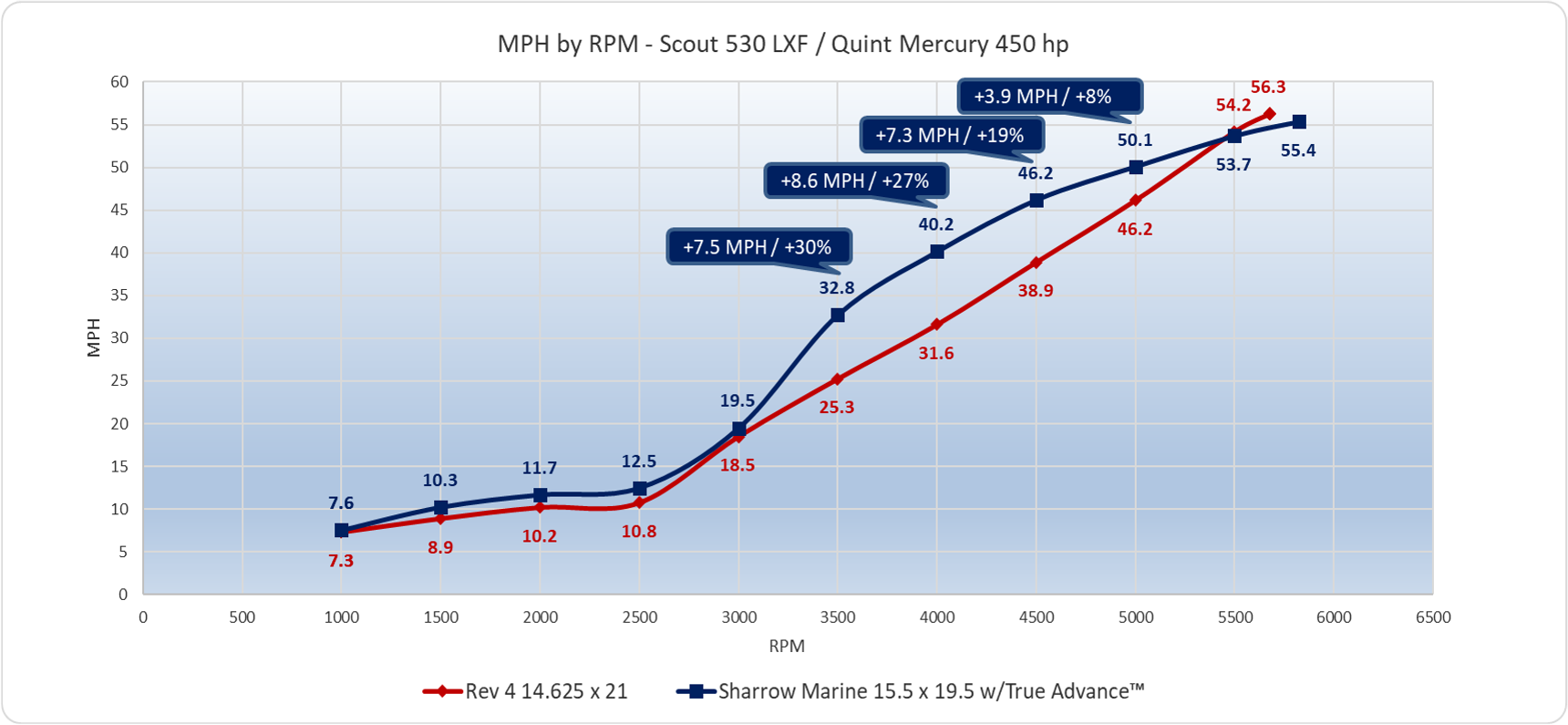
The MPH-by-RPM data shows the largest performance gains occurring throughout the boat's midrange and cruising RPM. At 3,500 RPM, the Sharrow-equipped boat reached 32.8 MPH versus 25.3 MPH, an increase of 7.5 MPH or 30%. At 4,000 RPM, the advantage was 7.3 MPH (19%), and at 4,500 RPM the Sharrow setup was 7.3 MPH (27%) faster. Even at 5,000 RPM, the Sharrow propellers maintained a 3.9 MPH (8%) advantage.
At the upper end of the RPM range, the comparison changes. The stock Rev 4 propellers reached approximately 56.3 MPH, while the Sharrow setup reached approximately 55.4 MPH. This represents a difference of less than 1 MPH at the top end. Importantly, the Sharrow propellers are still operating within the manufacturer's recommended WOT RPM range, so the slightly lower peak speed does not indicate an under-revving or improperly loaded engine. For this particular customer, who does not operate the boat at WOT in normal use, the small difference in maximum speed is therefore not a meaningful performance limitation.
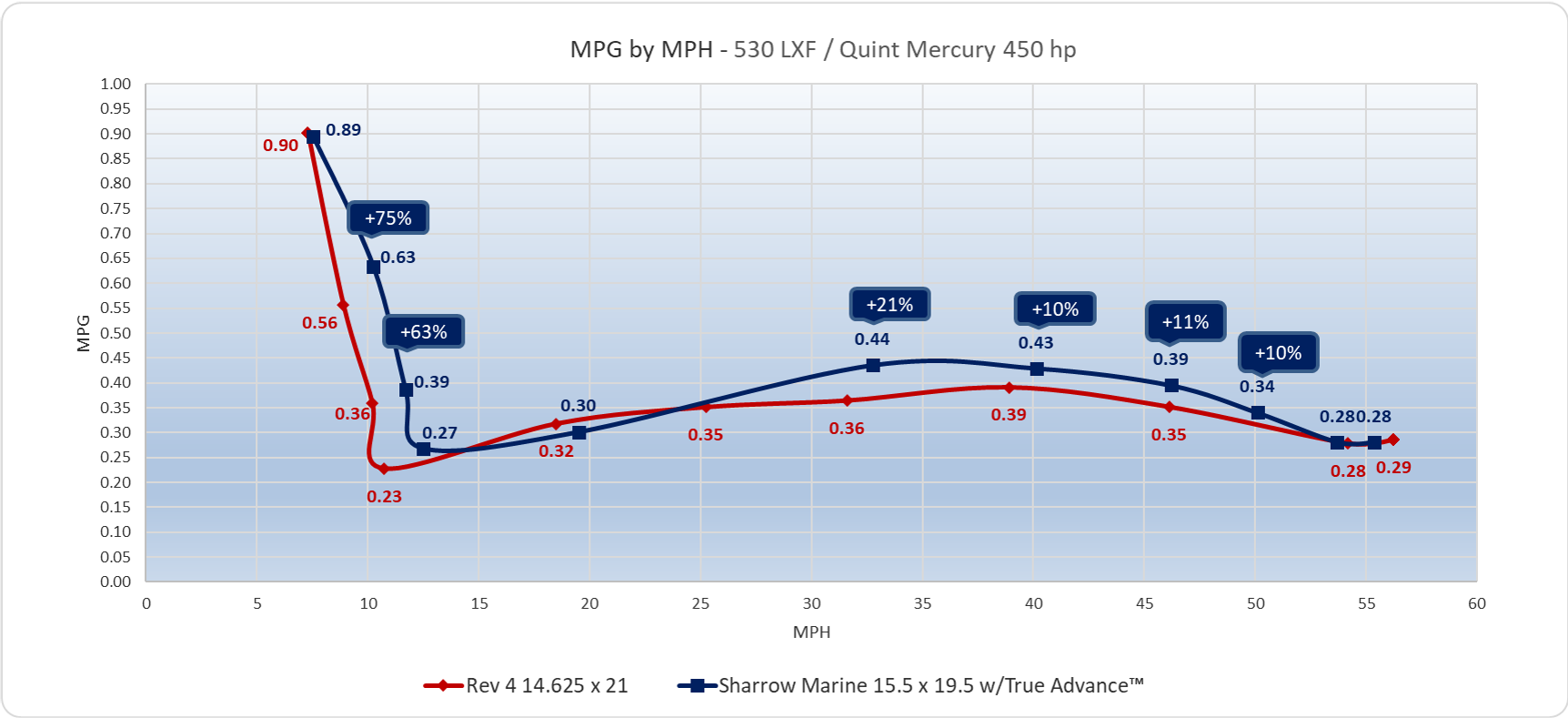
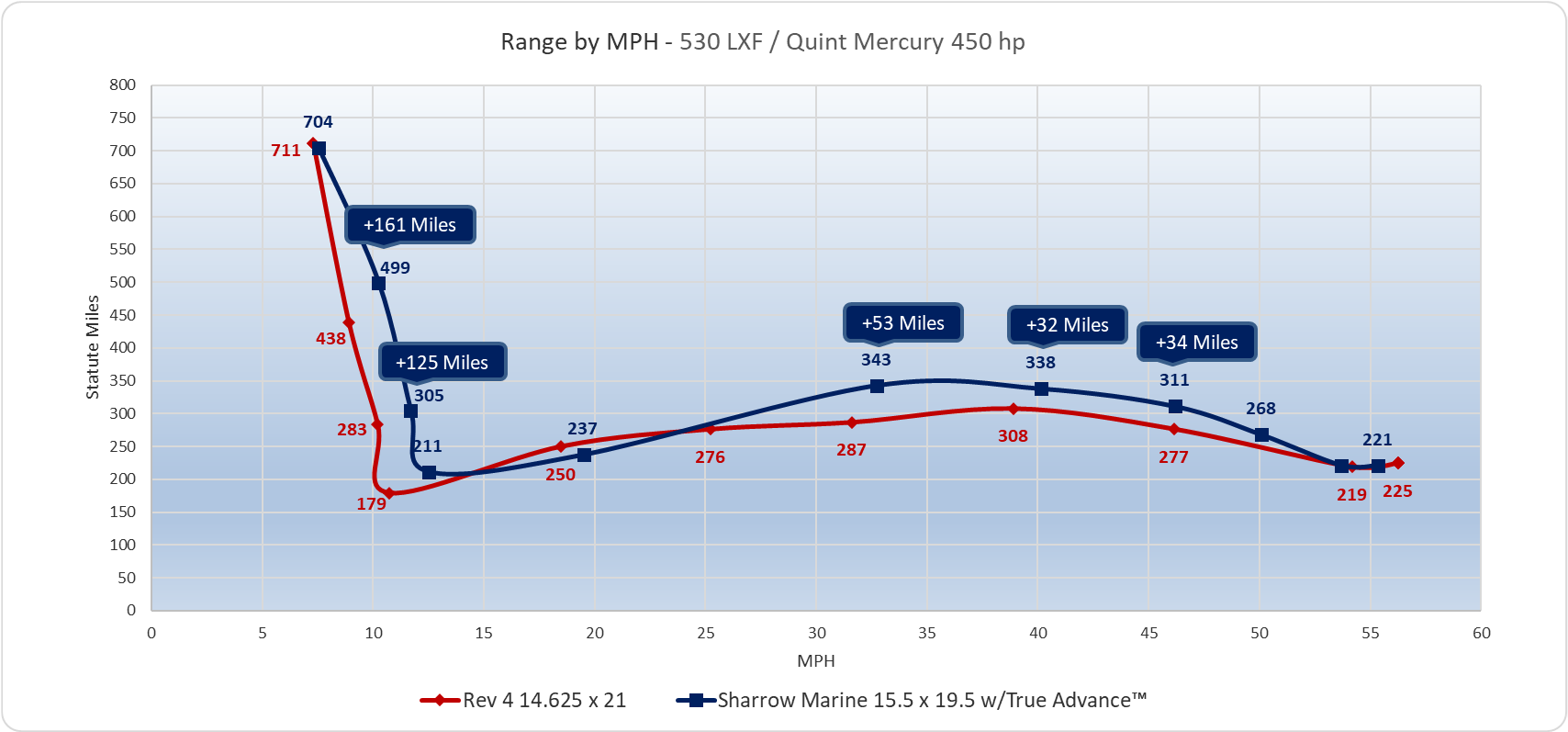
The efficiency data is where the Sharrow advantage becomes particularly compelling. The MPG-by-MPH graph shows improved fuel economy across the primary cruising range, including approximately 21% improvement around 33 MPH, 10% at 40 MPH, 11% around 46 MPH, and 10% around 50 MPH. This translates directly into greater usable range. At approximately 33–46 MPH, the range graph shows the Sharrow setup providing roughly 30–55 additional statute miles, depending on cruising speed.
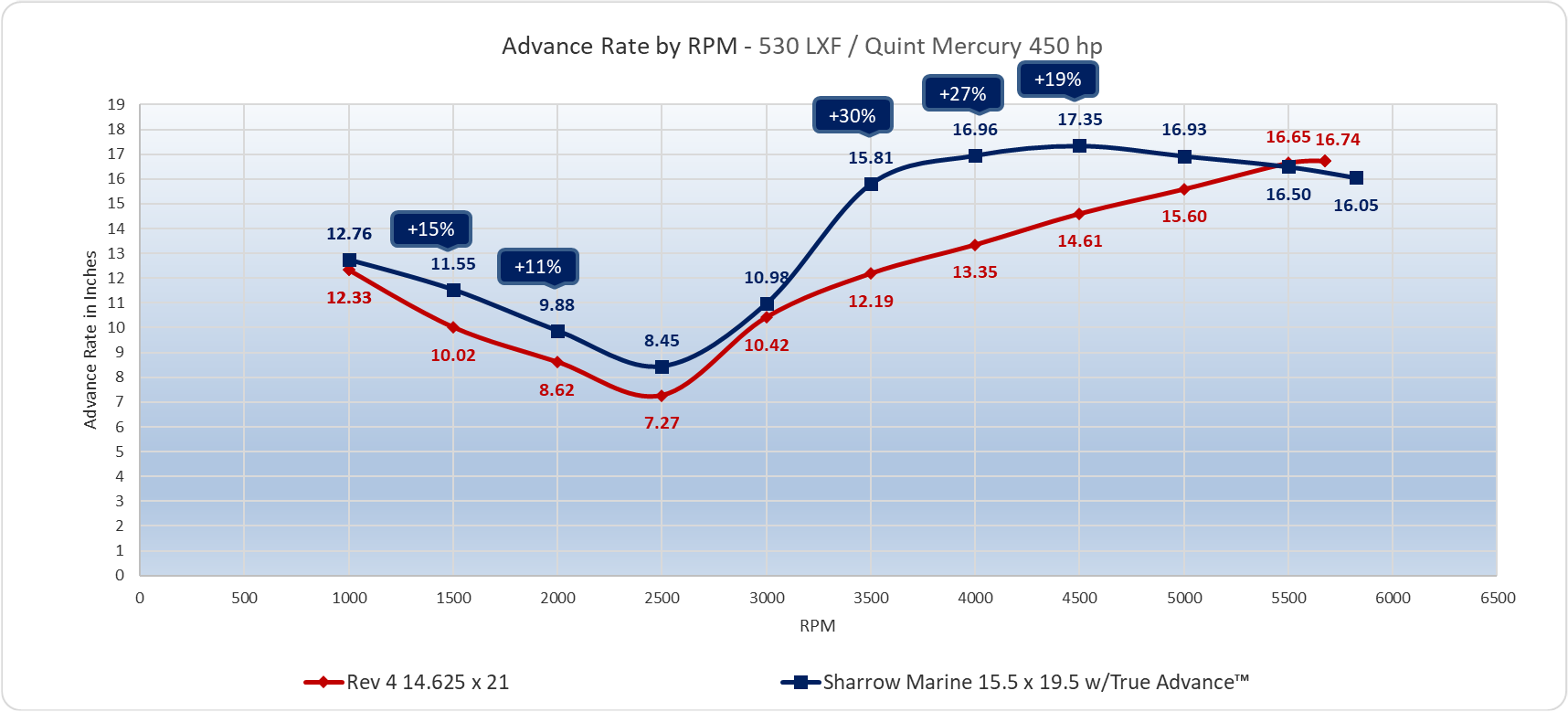
The Advance Rate-by-RPM graph provides additional insight into the hydrodynamic difference. Sharrow maintains a higher advance rate throughout most of the operating range, with improvements reaching 30% at 3,500 RPM, 27% at 4,000 RPM, and 19% at 4,500 RPM. In practical terms, this means the propeller is advancing the boat farther per revolution and converting the available engine power into forward motion more effectively.
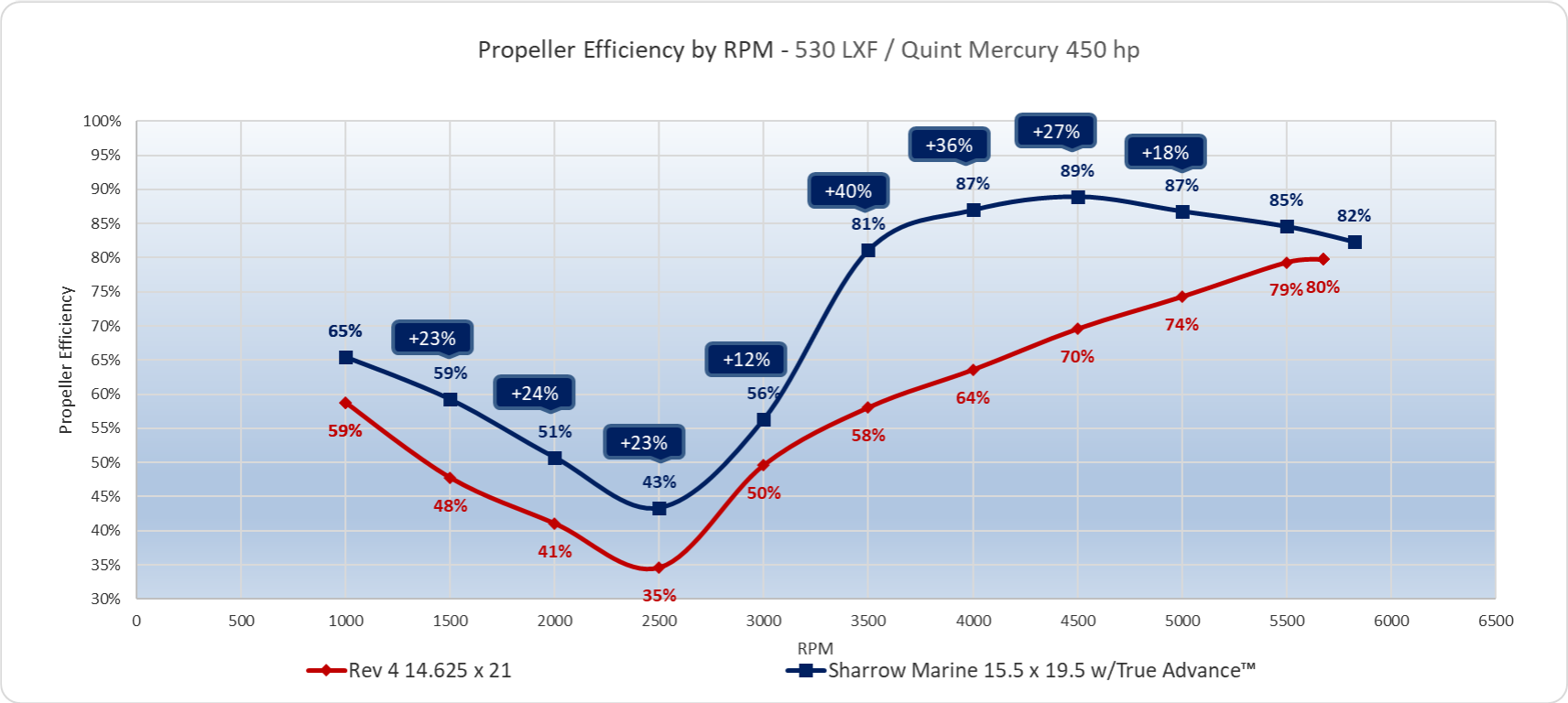
The propeller-efficiency data reinforces this result. Sharrow efficiency reaches 81% at 3,500 RPM, 87% at 4,000 RPM, and 89% at 4,500 RPM, compared with 58%, 64%, and 70%, respectively, for the Rev 4. That represents efficiency improvements of approximately 40%, 36%, and 27% at those RPM points.
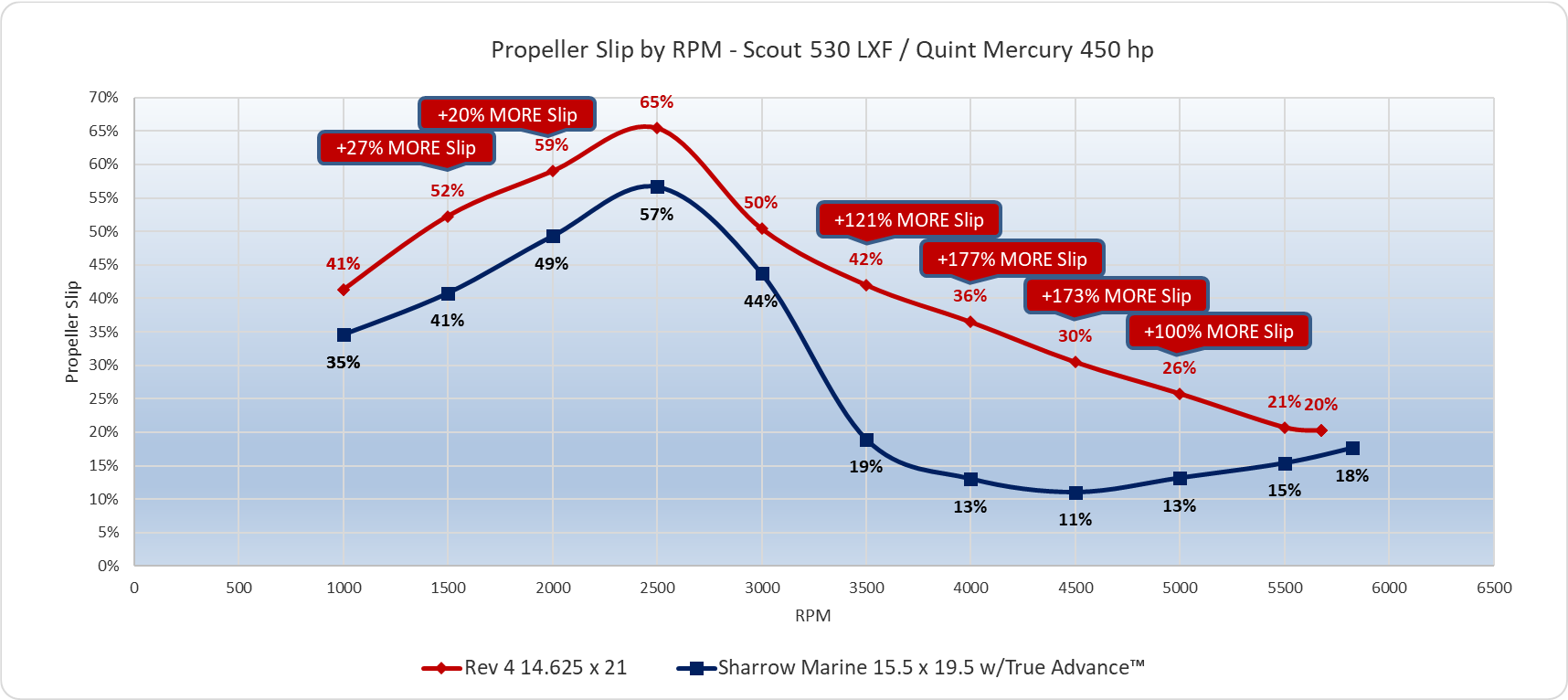
Finally, the propeller-slip graph helps explain the performance difference. From 3,500 RPM onward, Sharrow dramatically reduces slip—from 42% to 19% at 3,500 RPM, 36% to 13% at 4,000 RPM, and 30% to just 11% at 4,500 RPM. Lower slip indicates that less of the propeller's rotational motion is being lost and more is being converted into useful forward thrust.
The Sharrow propellers deliver substantially more speed at the same RPM, better propulsive efficiency, lower slip, improved MPG, and increased cruising range throughout the operating range this customer uses. The approximately 1 MPH reduction in absolute top speed is a minor tradeoff, particularly given that the Sharrow setup remains within the recommended WOT RPM range and the customer does not operate the vessel at WOT.
Schedule your free Sharrow Propeller™ consultation
Connecting with our experts is the first step in selecting and building your custom Sharrow Propeller. We’ll discuss any issues you’re encountering with your current prop and get more details on how you’d like to optimize your time on the water. Then we’ll walk you through the order and customization process.