
SHARROW PROPELLERS OUTPERFORM TWO MERCURY PROP OPTIONS ON NOR-TECH 392 WITH QUAD MERCURY 350 HP OUTBOARDS
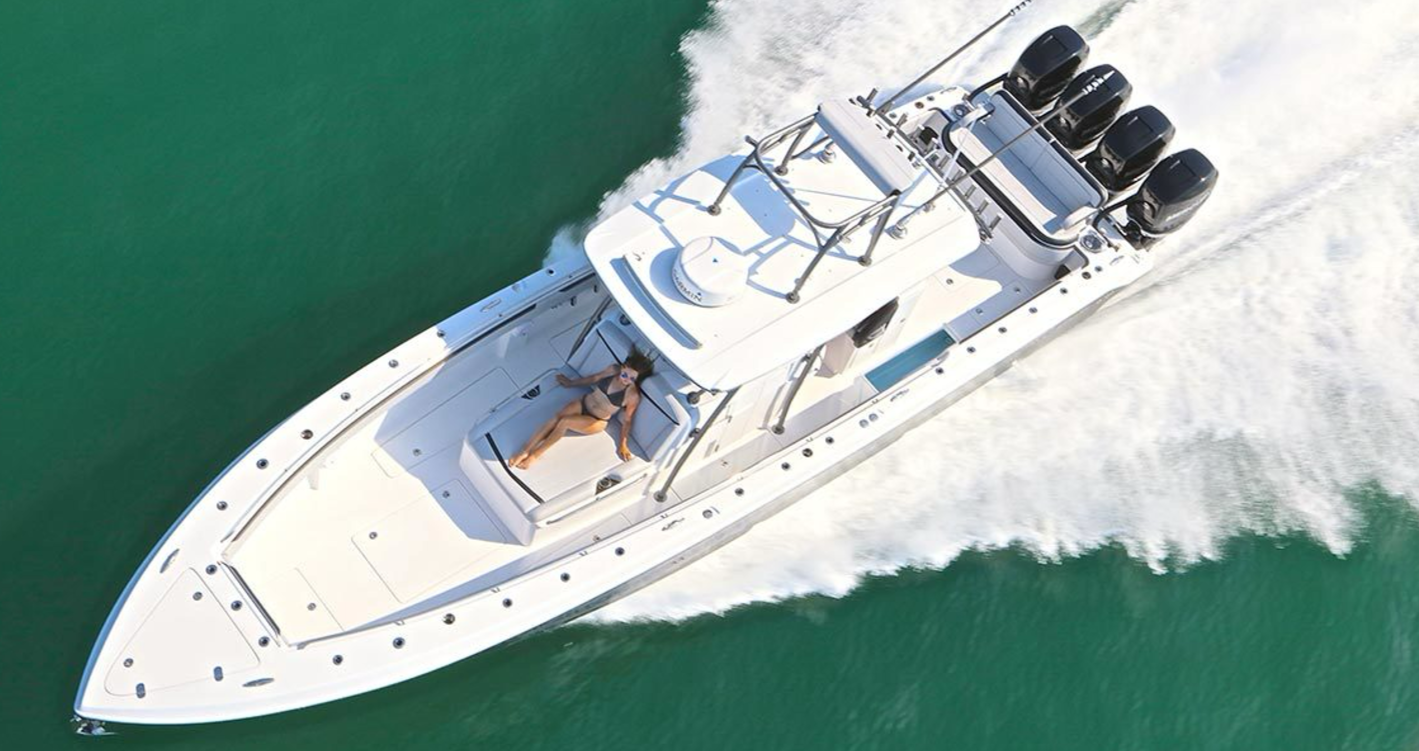
The Nor-Tech 392 testing provides a particularly useful look at propeller performance because the same Sharrow Marine 15.5" × 22" propeller was compared independently against both the Mercury Rev 4 14.75" × 23" 4-Blade and Enertia Eco 16" × 23". Across the test data, Sharrow demonstrates a consistent advantage in the areas that most directly indicate propulsive efficiency: speed at a given RPM, MPG, propeller efficiency, slip, and advance rate.
The most important takeaway is that the Sharrow advantage is not dependent on outperforming one particular OEM propeller design. On this Nor-Tech 392, the same Sharrow propeller demonstrated significant improvements when compared independently against both the Mercury Rev 4 and Mercury Enertia Eco. The magnitude of the improvement changes depending on which conventional propeller is used as the baseline, but the underlying pattern remains remarkably consistent:
More advance → less slip → higher propeller efficiency → more boat speed at the same RPM → improved fuel economy.
The Rev 4 comparison shows particularly dramatic gains in the 2,000–3,500 RPM range, while the Enertia Eco comparison demonstrates that Sharrow can maintain a meaningful advantage even against a different Mercury propeller design optimized for efficiency.
Sharrow vs. Mercury Rev 4
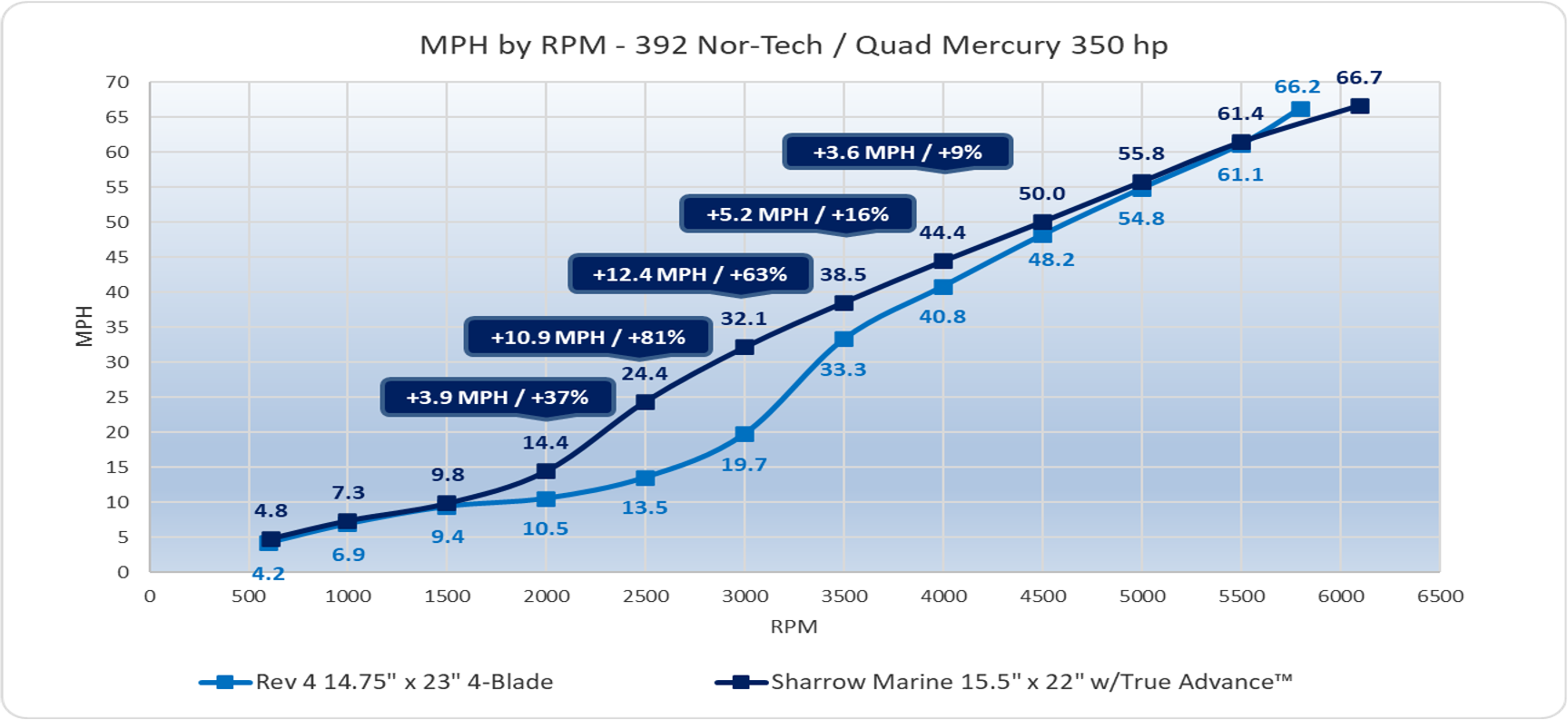
Against the Rev 4, the Sharrow propeller produced its largest speed advantage through the midrange. At 2,000 RPM, Sharrow produced 14.4 MPH versus 10.5 MPH, a 3.9 MPH / 37% increase. At 2,500 RPM, the difference increased to 10.9 MPH / 81%, with Sharrow reaching 24.4 MPH compared with 13.5 MPH. At 3,000 RPM, Sharrow reached 32.1 MPH versus 19.7 MPH, a 12.4 MPH / 63% advantage. Even at 3,500 RPM, the Sharrow-equipped boat maintained a 5.2 MPH / 16% advantage.
At the upper end, the gap naturally narrows as both propellers approach their maximum speed. Sharrow reached 66.7 MPH at 6,000 RPM, compared with 66.2 MPH for the Rev 4.
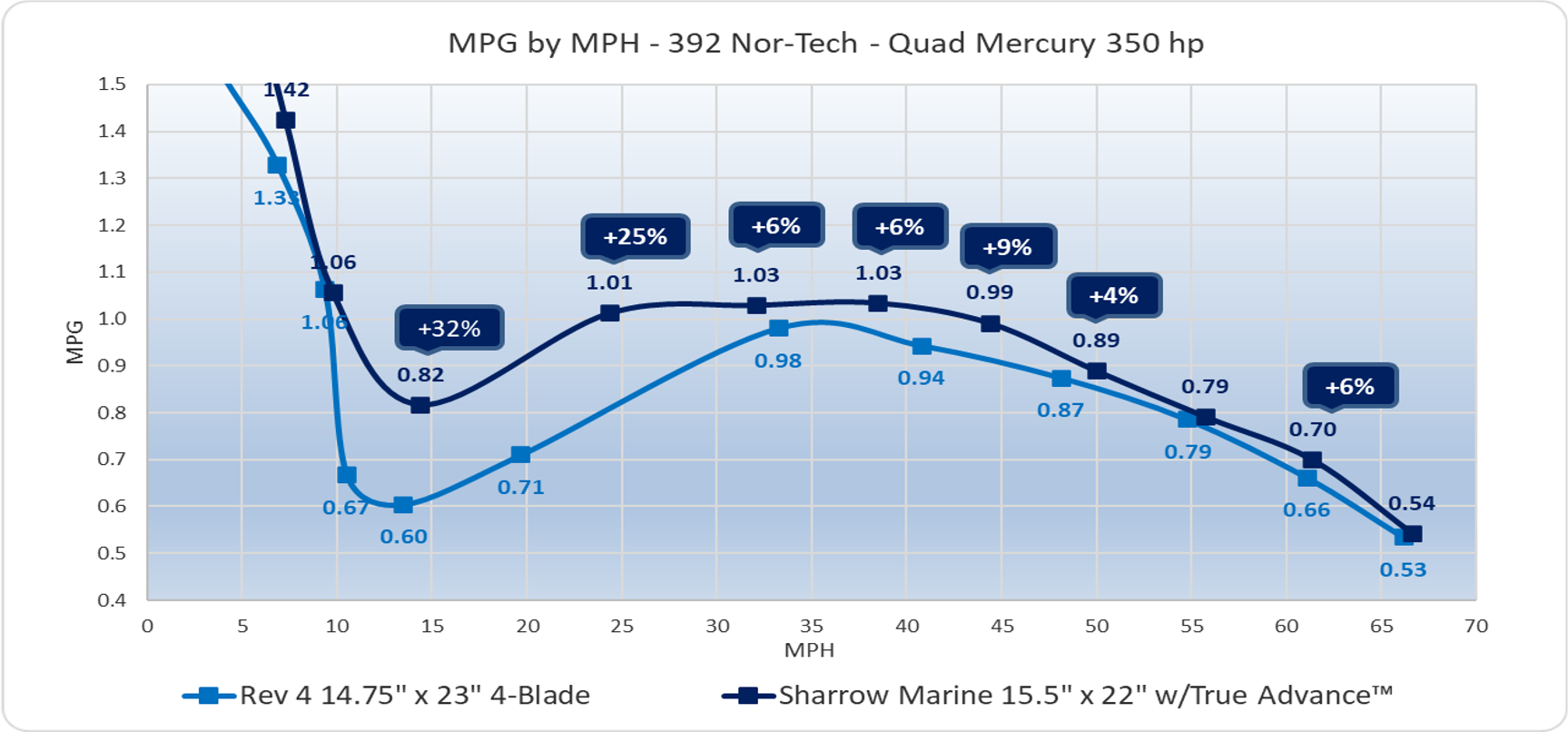
The MPG-by-MPH comparison shows that the speed advantage is accompanied by improved efficiency. Sharrow produced 25% better MPG at approximately 25 MPH, 6% at 33–38 MPH, 9% around 45 MPH, and continued to show a 4–6% advantage through approximately 50–63 MPH.
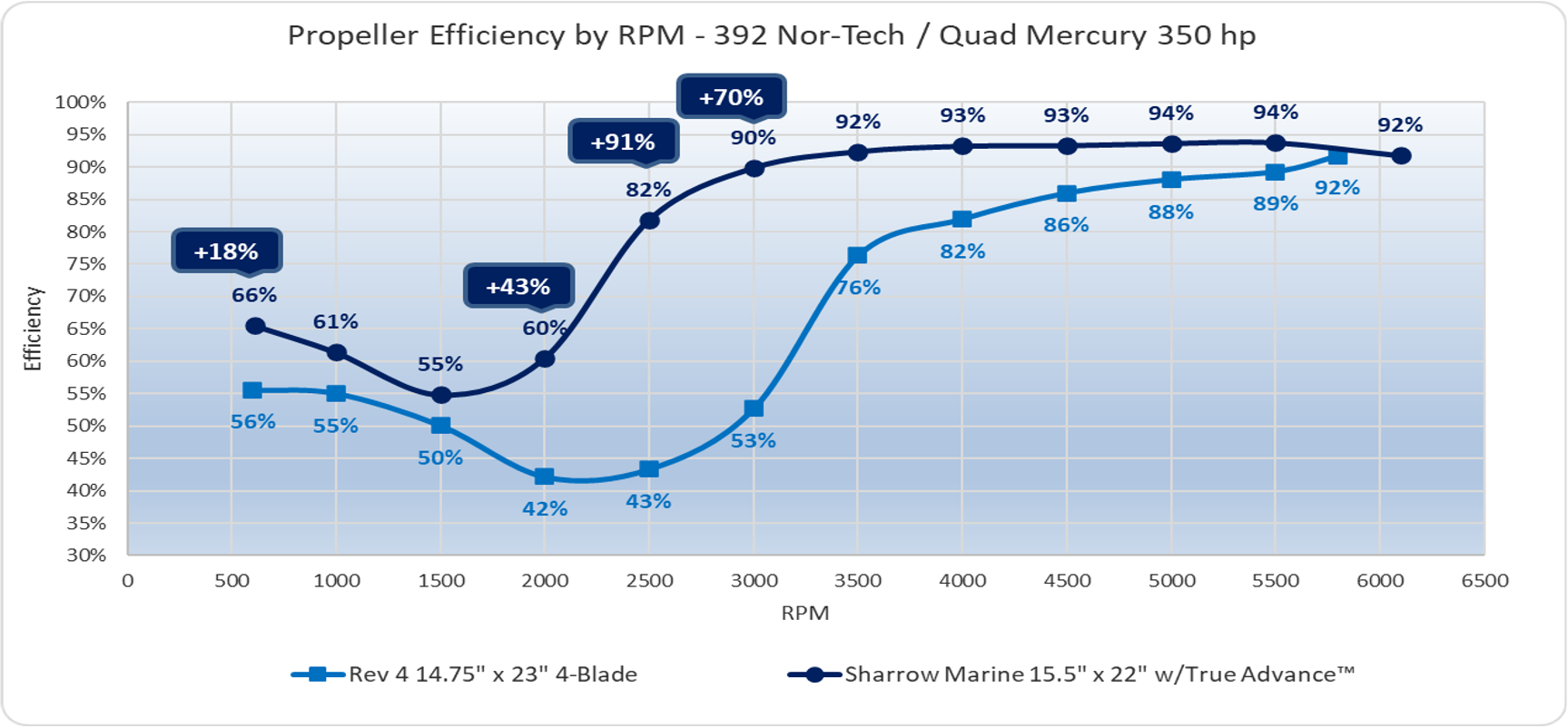
The underlying propeller data explains these results. Sharrow efficiency reached 82% at 2,500 RPM and 90% at 3,000 RPM, compared with just 43% and 53% for the Rev 4. That's approximately 91% and 70% greater propeller efficiency, respectively. By 3,500 RPM, Sharrow was operating at 92% efficiency versus 76% for the Rev 4.
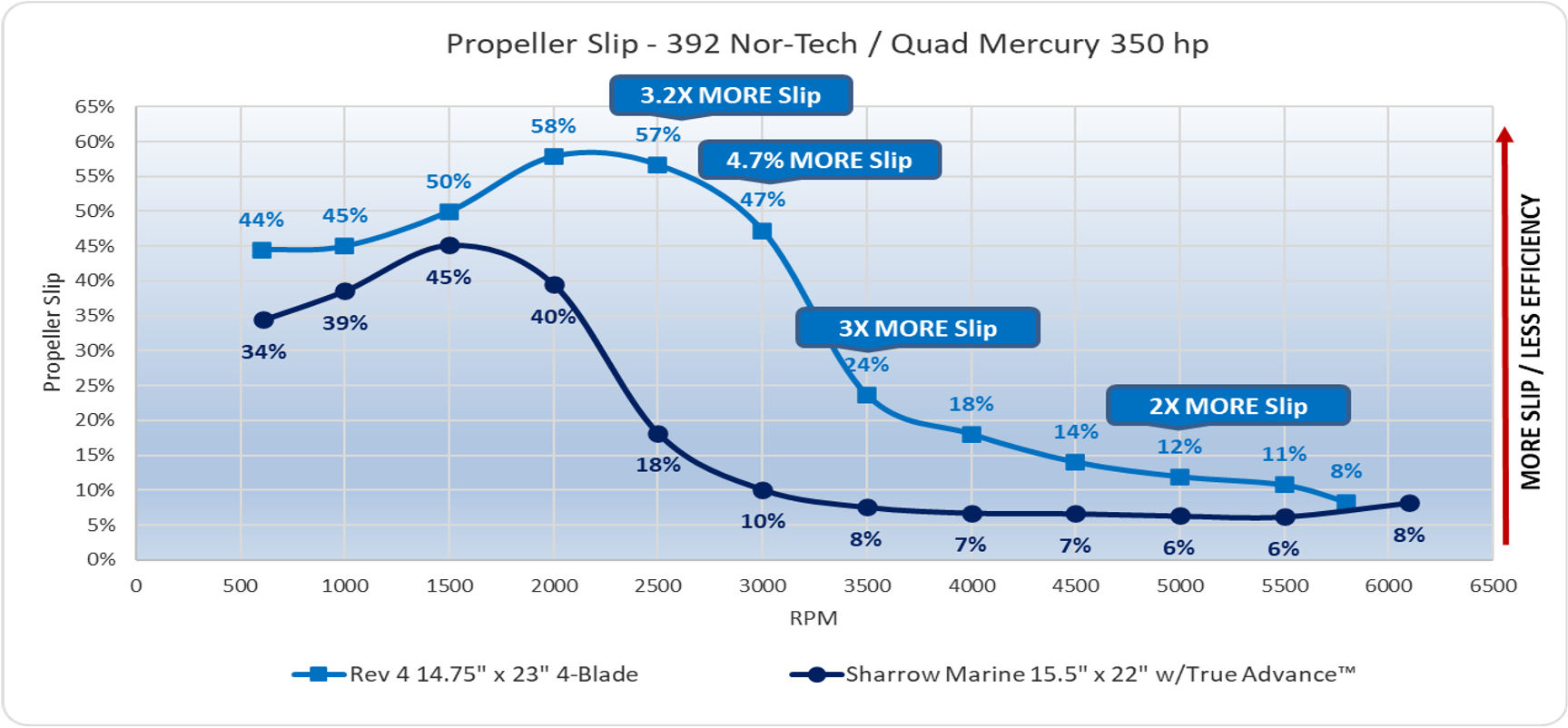
The slip data is even more revealing. At 2,500 RPM, the Rev 4 showed 57% slip, compared with only 18% for Sharrow. At 3,000 RPM, the figures were 47% versus 10%, and at 3,500 RPM, 24% versus 8%. In other words, Sharrow is substantially reducing the amount of propeller rotation that is not being converted into forward motion.
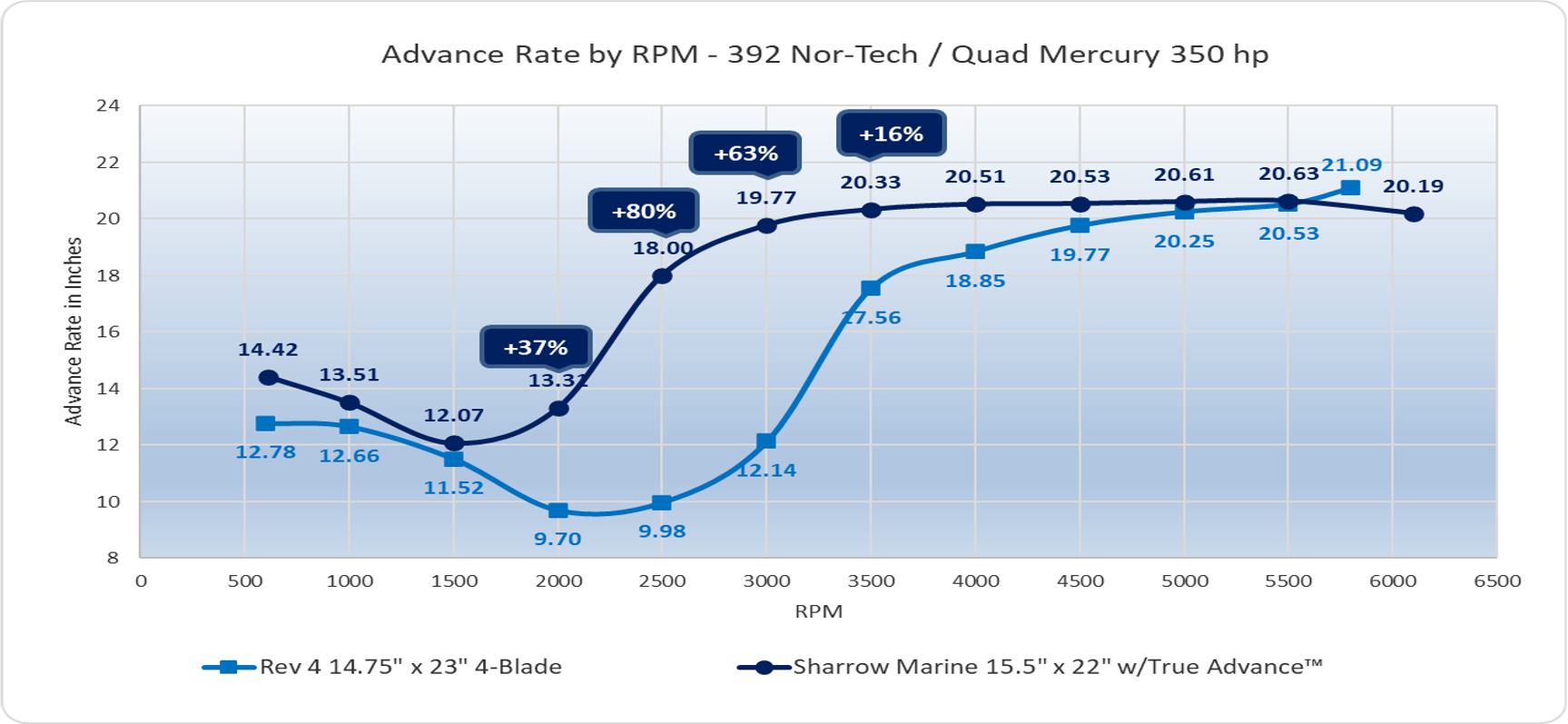
The advance-rate graph reinforces the same conclusion. At 2,500 RPM, Sharrow produced an 18.00-inch advance rate versus 9.98 inches for the Rev 4—an 80% improvement. At 3,000 RPM, the advantage remained 63%, with Sharrow at 19.77 inches versus 12.14 inches. By 3,500 RPM, Sharrow maintained a 16% advantage.
Sharrow vs. Mercury Enertia Eco
The comparison with the Enertia Eco follows the same general pattern, although the magnitude of the advantage varies somewhat by operating point.
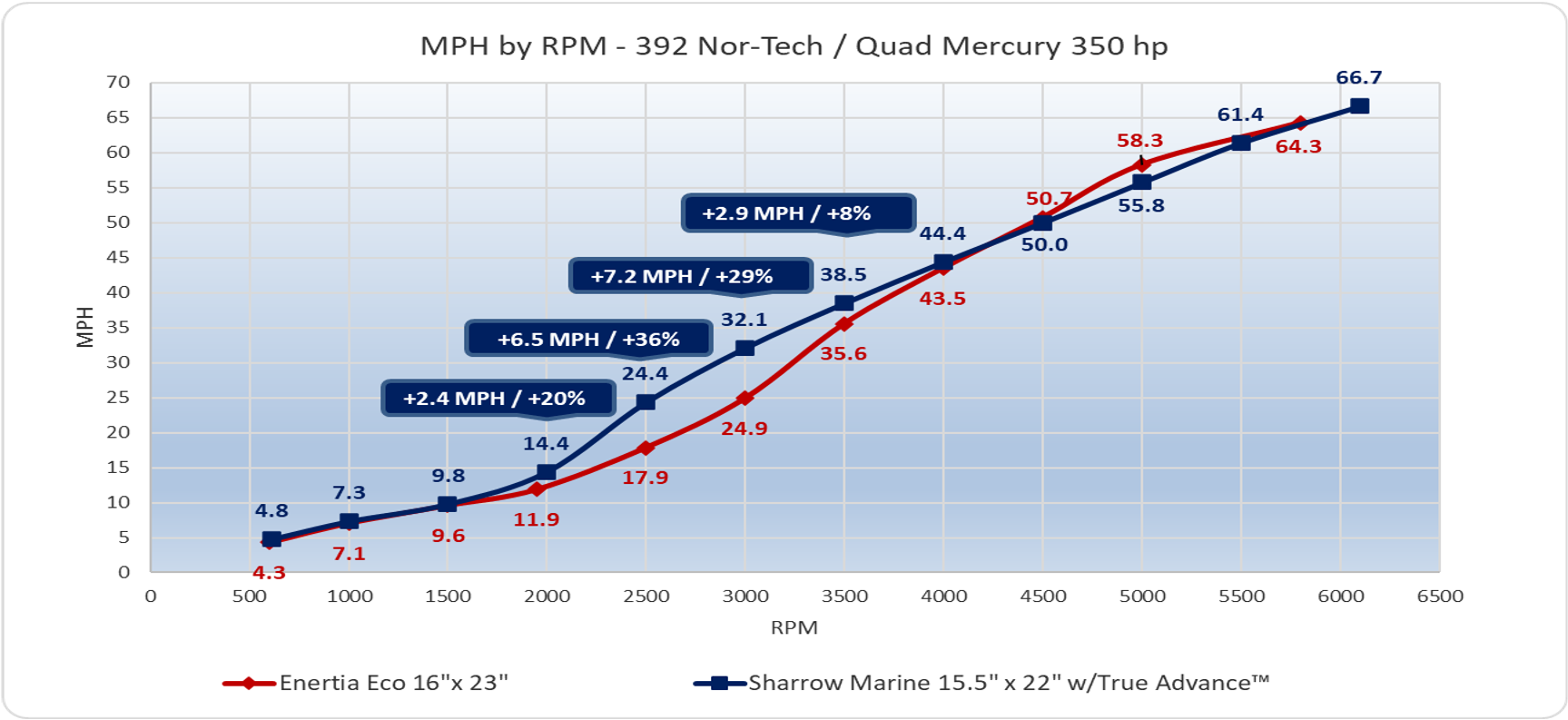
At 2,000 RPM, Sharrow produced 14.4 MPH versus 11.9 MPH, a 2.4 MPH / 20% improvement. At 2,500 RPM, the difference increased to 6.5 MPH / 36%, and at 3,000 RPM, Sharrow reached 32.1 MPH versus 24.9 MPH, a 7.2 MPH / 29% advantage. At 3,500 RPM, the Sharrow setup remained 2.9 MPH / 8% faster.
The curves converge at higher speeds. The Enertia Eco reached 58.3 MPH at 5,000 RPM, compared with 55.8 MPH for Sharrow at that RPM, while at 5,500 RPM the two were again nearly identical. Sharrow ultimately reached 66.7 MPH at 6,000 RPM, compared with 64.3 MPH for the Enertia Eco.
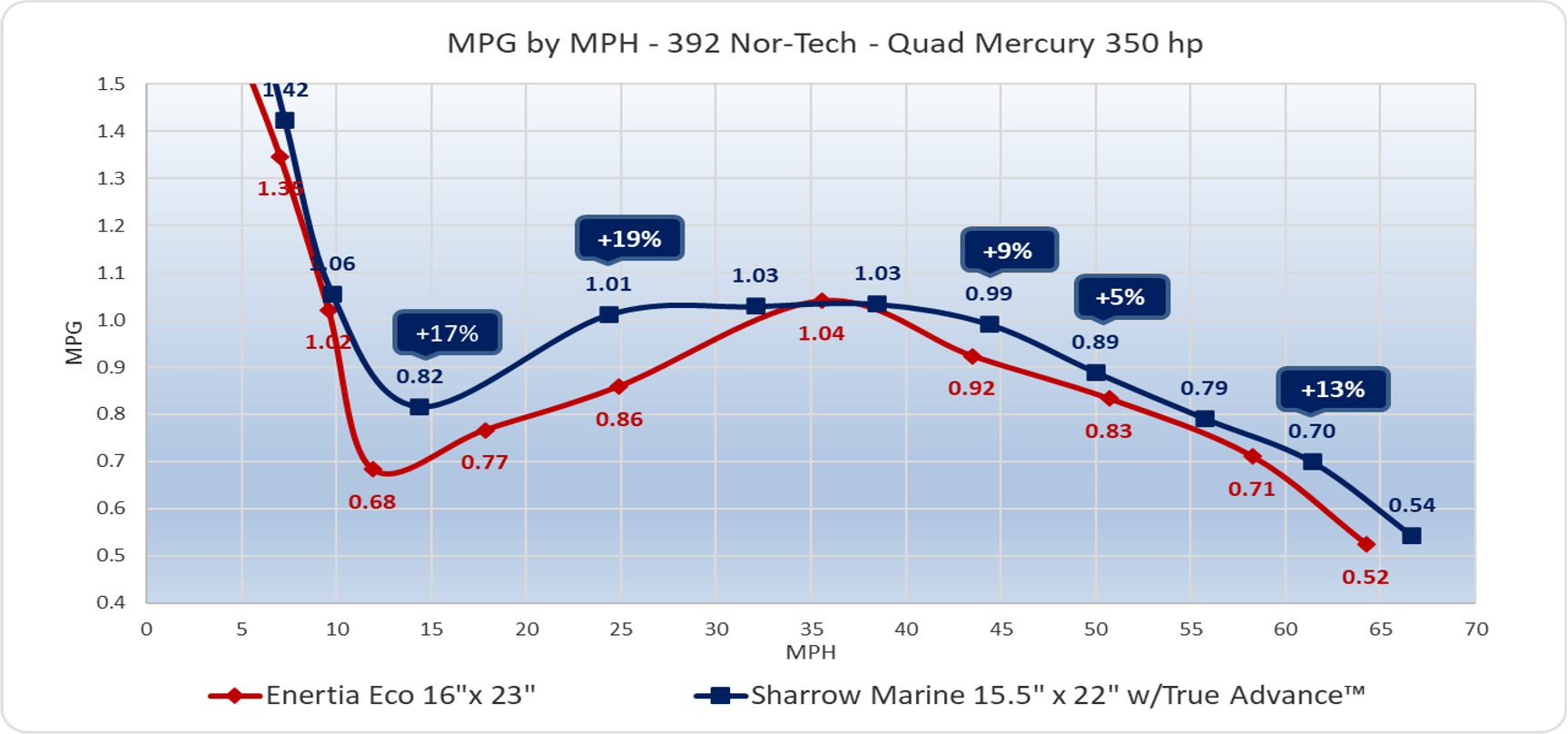
Again, the fuel-efficiency data favors Sharrow across most of the practical cruising range. Sharrow showed 17% better MPG around 15 MPH, 19% at 25 MPH, 9% around 45 MPH, 5% around 50 MPH, and 13% around 63 MPH. The largest efficiency advantage occurs in the lower-to-mid cruising range, where the Sharrow propeller is converting engine power more effectively.
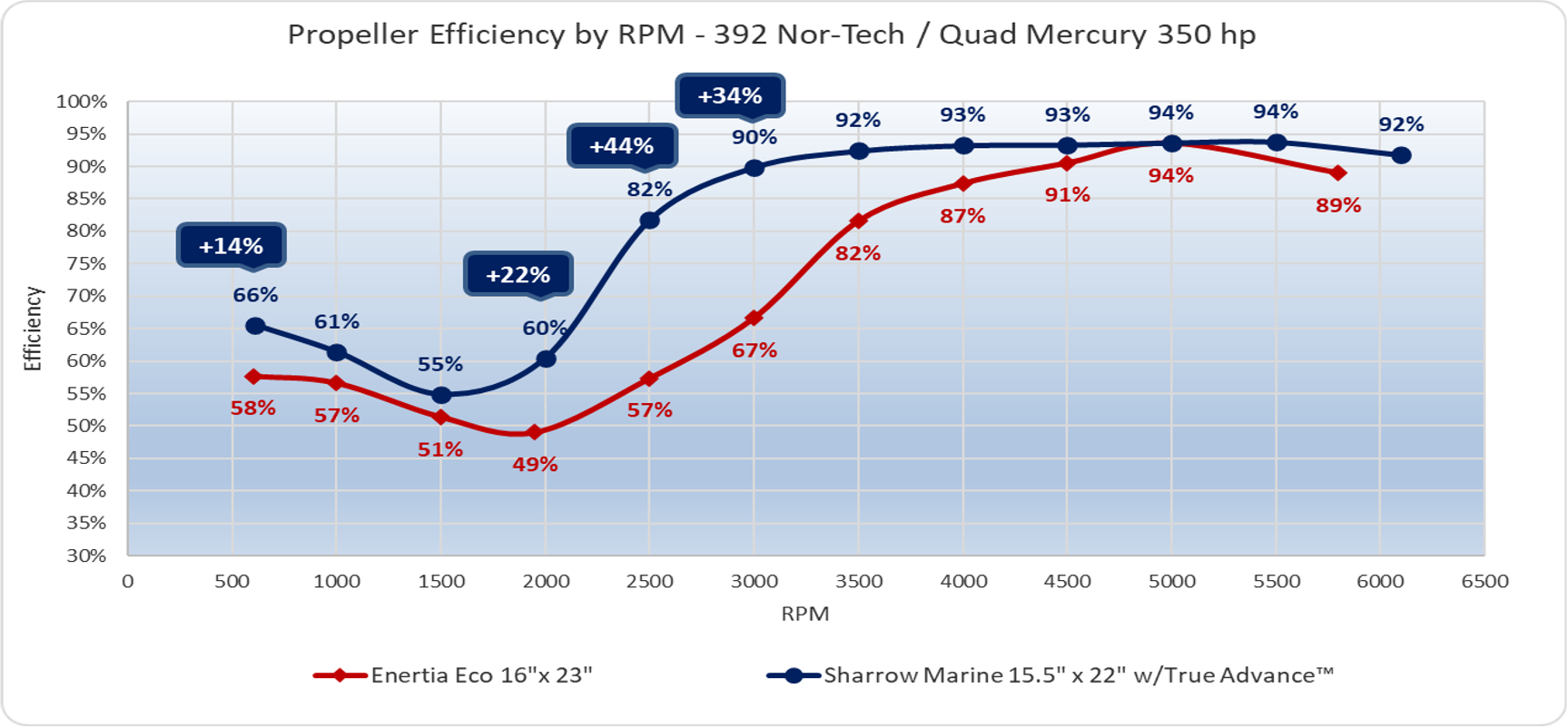
The propeller-efficiency data provides a clear explanation. At 2,500 RPM, Sharrow was operating at 82% efficiency versus 57% for the Enertia Eco, a 44% improvement. At 3,000 RPM, Sharrow reached 90% versus 67%, a 34% improvement. At 3,500 RPM, both were at approximately 82%, but Sharrow's efficiency advantage returns at higher RPM before the curves converge around 5,000 RPM.
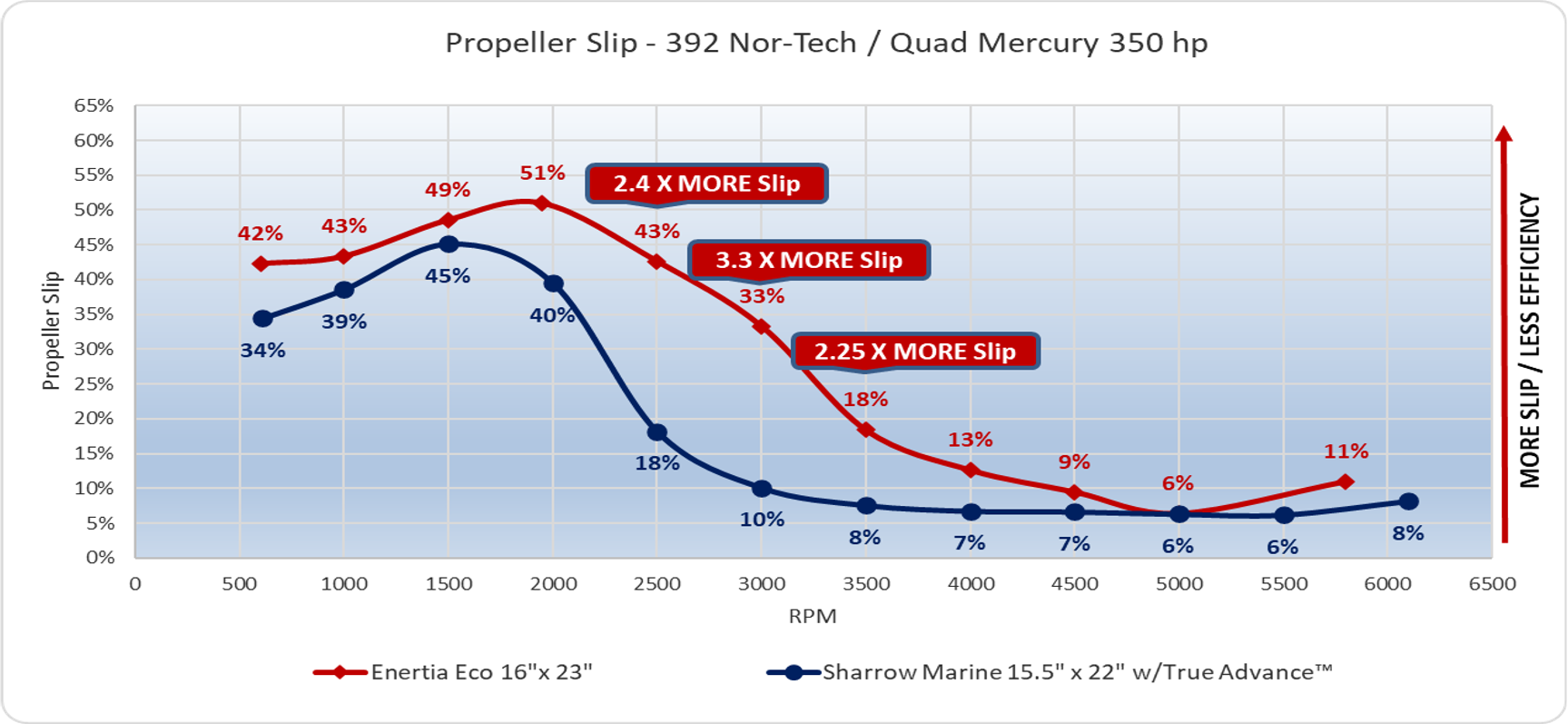
Slip is similarly favorable. At 2,500 RPM, the Enertia Eco showed 43% slip versus 18% for Sharrow—approximately 2.4 times more slip. At 3,000 RPM, Enertia Eco showed 33% versus 10%, or 3.3 times more slip. At 3,500 RPM, the difference was 18% versus 8%, approximately 2.25 times more slip.
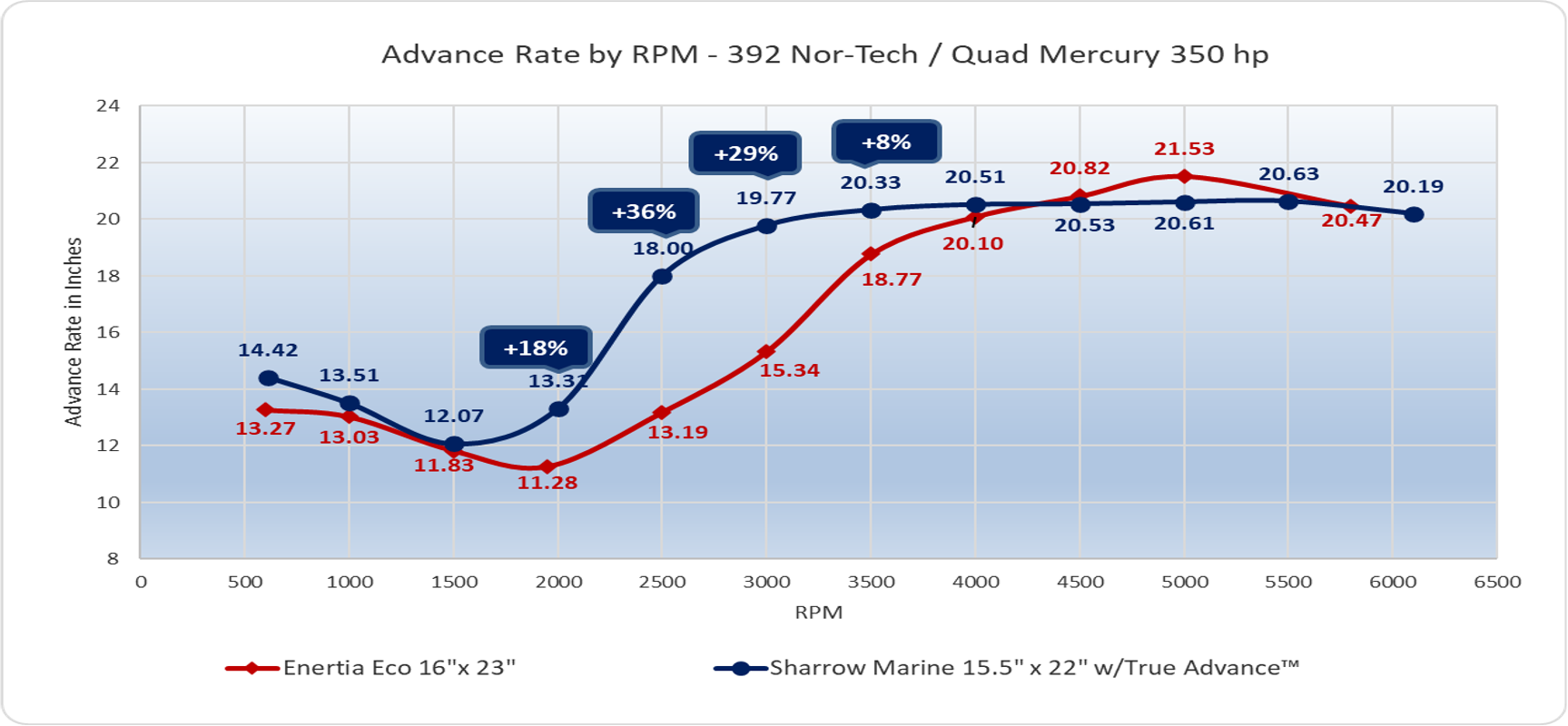
The advance-rate comparison follows the same pattern. Sharrow produced 18.00 inches versus 13.19 inches at 2,500 RPM, a 36% improvement, and 19.77 versus 15.34 inches at 3,000 RPM, a 29% improvement. At 3,500 RPM, Sharrow remained 8% higher.
Schedule your free Sharrow Propeller™ consultation
Connecting with our experts is the first step in selecting and building your custom Sharrow Propeller. We’ll discuss any issues you’re encountering with your current prop and get more details on how you’d like to optimize your time on the water. Then we’ll walk you through the order and customization process.